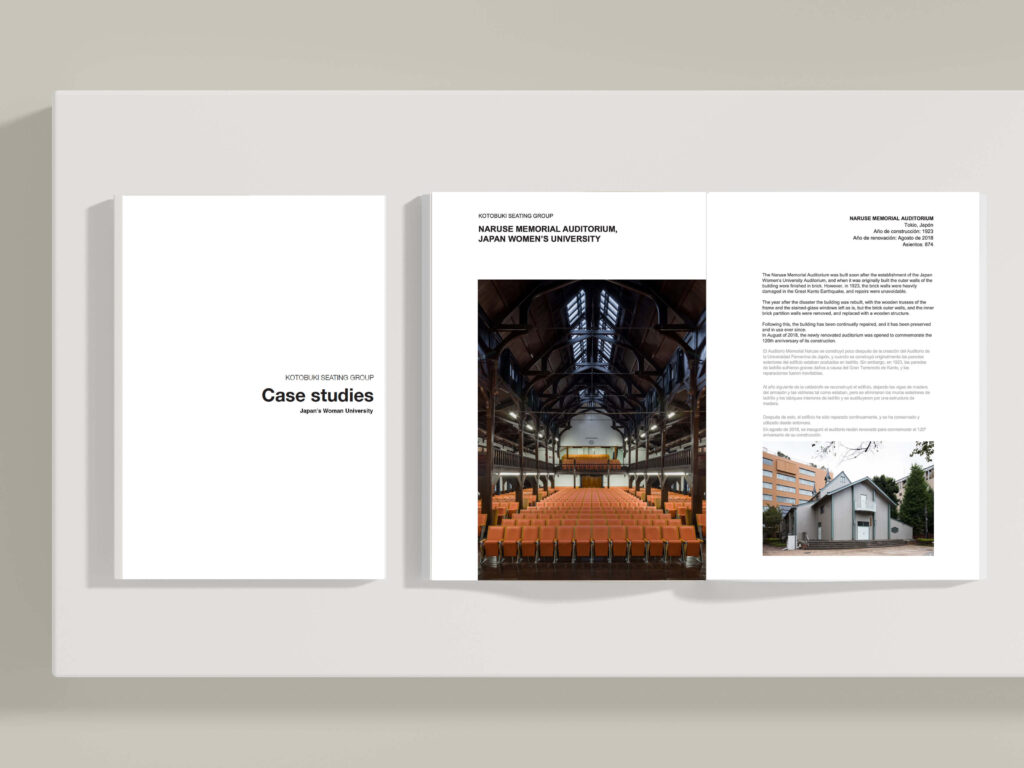
- Location: Tokyo, Japan
- Construction: 1923
- Renovation: 2018
- Number of seats: 874
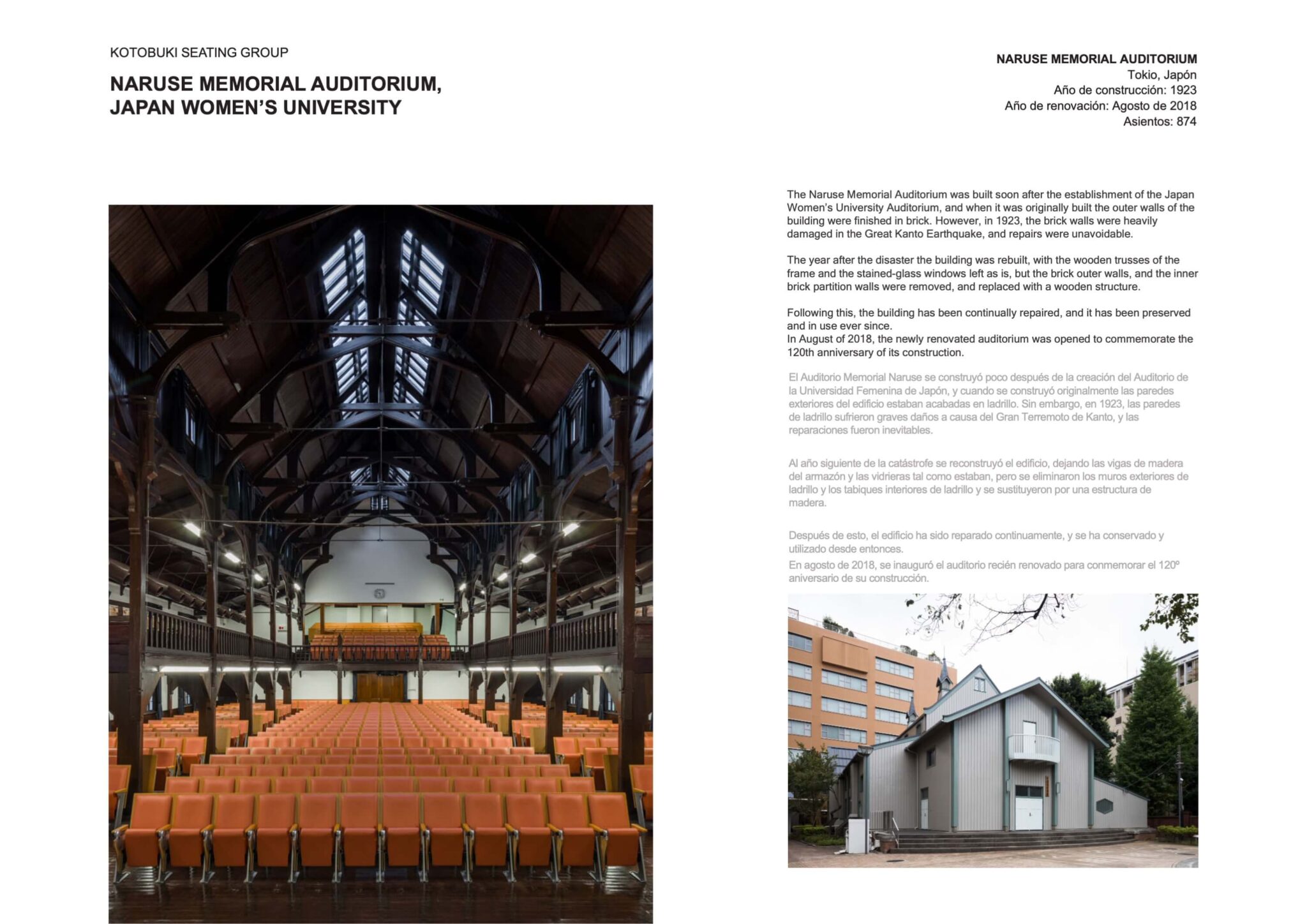
Naruse Memorial Auditorium was built shortly after the establishment of the Japan Women’s University Auditorium, and when it was originally constructed the exterior walls of the building were finished in brick. However, in 1923, the brick walls were severely damaged by the Great Kanto Earthquake, and repairs were unavoidable.
The year following the disaster, the building was rebuilt, leaving the wooden truss beams and stained glass windows as they were, but the exterior brick walls and interior brick partitions were removed and replaced with a wooden structure.
After this, the building has been continuously repaired, and has been preserved and used ever since. In August 2018, the newly renovated auditorium was inaugurated to commemorate the 120th anniversary of its construction.
A renovation of the public seating to continue more than a century of tradition.
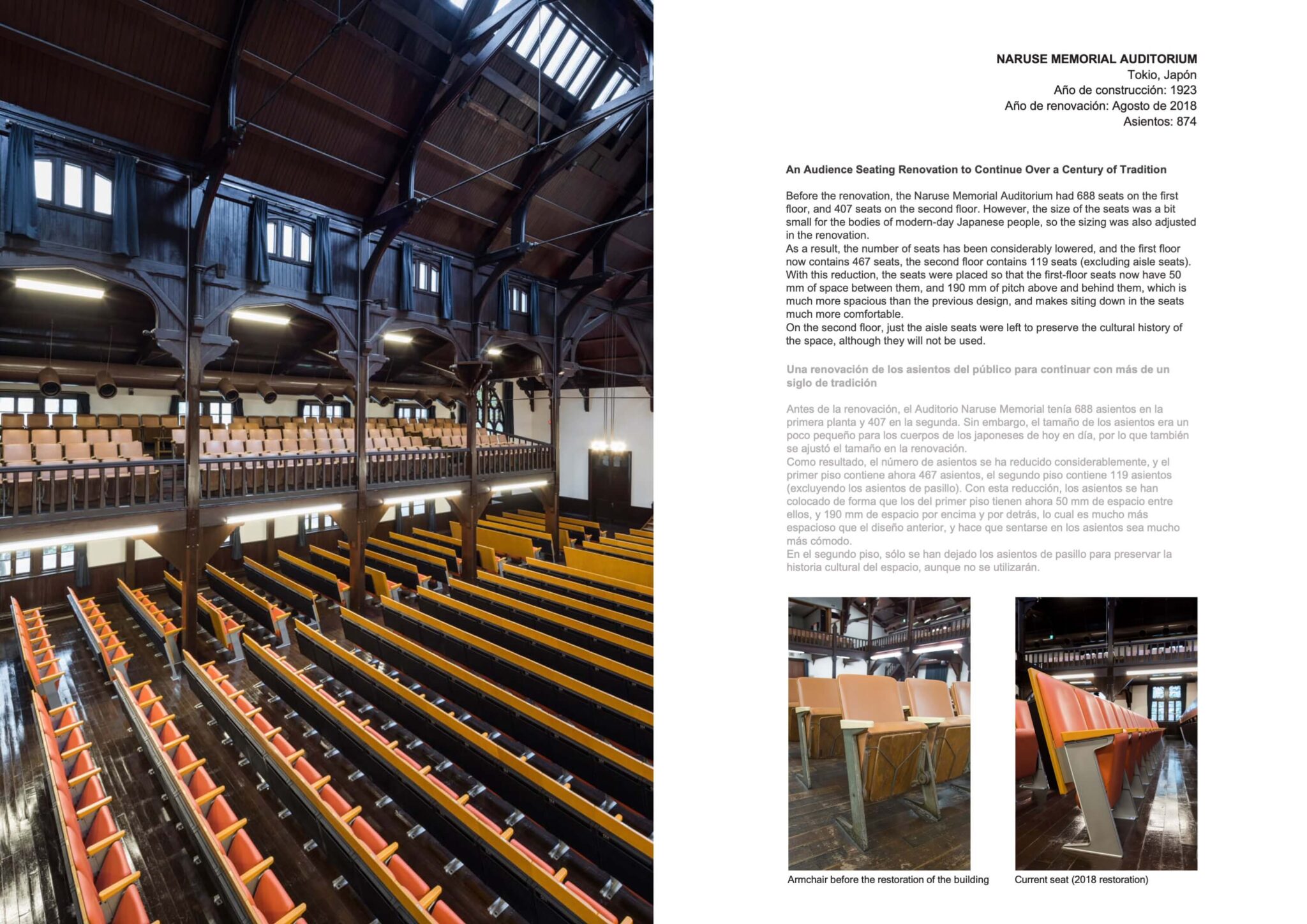
Before the renovation, Naruse Memorial Auditorium had 688 seats on the second floor and 407 seats on the second floor. However, the size of the seats was a bit small for the bodies of today’s Japanese, so the size was also adjusted in the renovation.
As a result, the number of seats has been reduced considerably, and the first deck now contains 467 seats, the second deck contains 119 seats (excluding aisle seats). With this reduction, the seats have been positioned so that the seats on the second floor now have 50 mm of space between them, and 190 mm of space above and behind, which is much more spacious than the previous design, and makes sitting in the seats much more comfortable.
On the second floor, only the aisle seats have been left to preserve the cultural history of the space, although they will not be used.
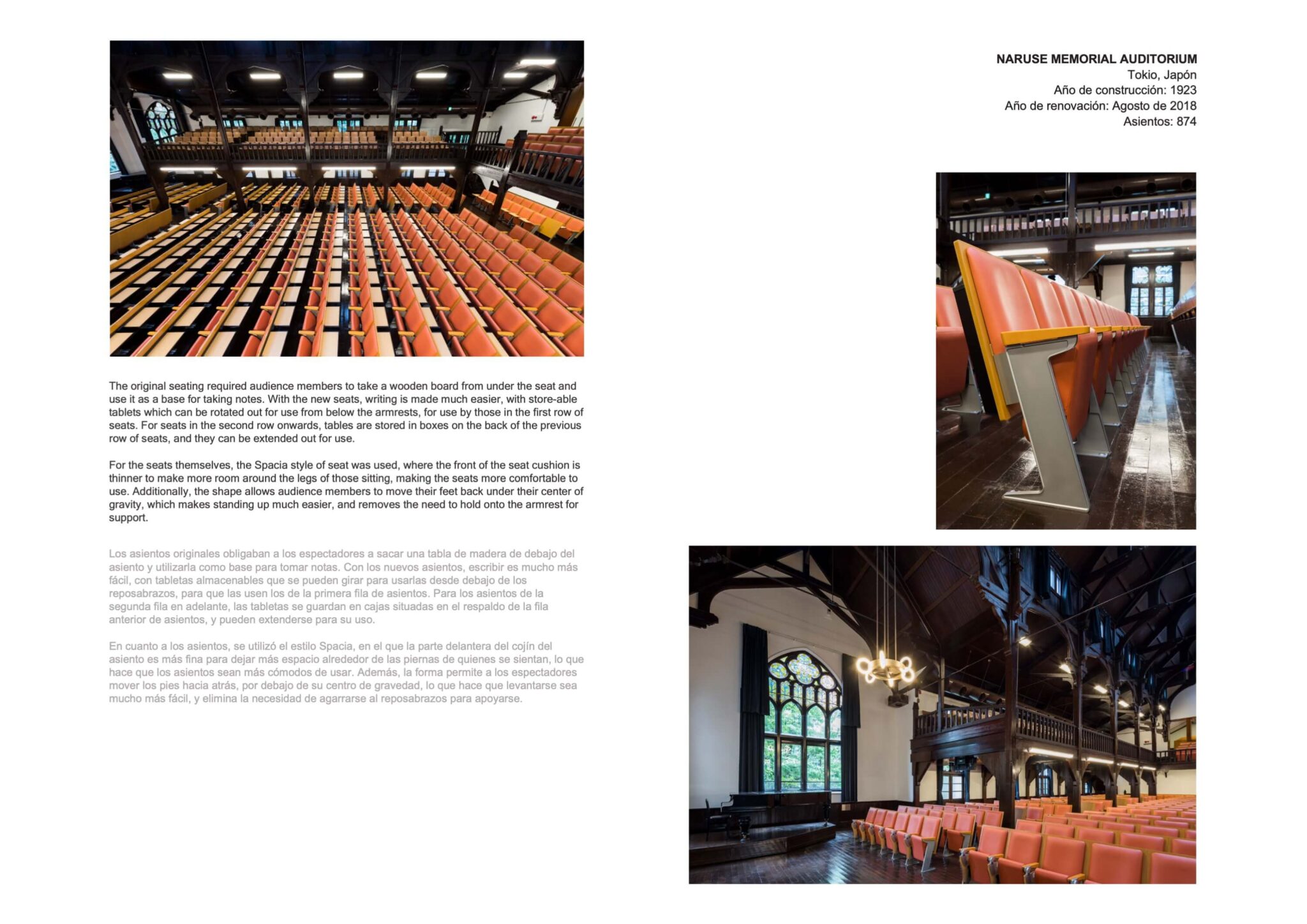
The original seats required spectators to pull a wooden board out from under the seat and use it as a base for taking notes. With the new seats, writing is much easier, with storable tablets that can be rotated for use from under the armrests, for use by those in the first row of seats. For second-row seats and up, tablets are stored in boxes located in the back of the front row of seats, and can be extended for use.
As for the seats, the Spacia style was used, in which the front of the seat cushion is thinner to leave more space around the legs of those sitting, making the seats more comfortable to use. In addition, the shape allows spectators to move their feet backwards, below their center of gravity, which makes getting up much easier, and eliminates the need to hold on to the armrest for support.